Nepal Oil Corporation (NOC) is the monopoly state company that deals with petroleum products—diesel, petrol, liquefied petroleum gas (LPg), kerosene and aviation fuel. It has the sole rights to purchase, transport, store, and distribute petroleum products. It purchases petroleum products from India, fixes prices with government consent and sells and distributes petroleum through private and public sector retailers and dealers. It is also the agency that can license petrol and diesel retailers.
Despite the monopoly, NOC has a history of huge losses, largely because prices were always artificially (politically) suppressed. almost every attempt to raise prices to match international prices has met with widespread protests because of the lack of transparency in how NOC conducts business. Both NOC and the government have justified every price hike as something necessitated by increasing losses. However, the same losses did not prevent NOC employees from receiving salaries and payments for up to as many as 27 months in a year under different budget lines. Further, there have been many reports in the media accusing NOC of indulging in corruption during price fixation, licensing, and transportation contracts, and while appointing dealers.
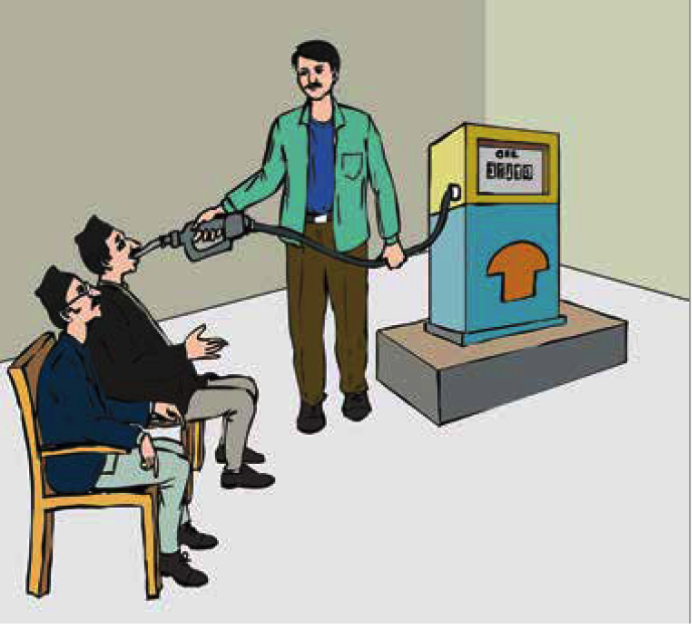
Following an attempt to raise prices in October 2011, the Minister for Supplies told the media that NOC faced loss- es because “of managerial lapses and distribution of free coupon(s),” in addition to the differences in the buying and selling rates (Karobar daily, 24 October 2011.) The information that some individuals obtained free coupons for petroleum products triggered an information request by Freedom Forum.
Process
The information request made on 06 December 2011 sought the following: 1. Number of coupons and volume of fuel distributed since 17 July 2006, names and addresses of individuals receiving free coupons, and of outlets that distributed free petroleum products 2. Certified copies of criteria or policy/directive, standard or decisions for distributing free coupons 3. The volume of oil and LP gas purchased, and dated cost and selling prices after 17 July 2006.
Upon failing to obtain information, Freedom Forum appealed to the NIC. NOC did not provide the information and informed Taranath Dahal of Freedom Forum that it did not have an Information Officer. Next Dahal filed another application addressed to the executive Director, also the appellate authority, (27 December 2011) requesting the same information, and reasons if it could not be disclosed. The executive Director provided neither the information nor the reasons for denial.
Dahal then appealed to the NIC on 16 January 2012, and on 19 January 2012 the Commission ordered NOC to provide the information within seven days or provide an explanation for not doing so. NOC did not comply following which the NIC sent a reminder on 15 Febru ary 2012, asking for the status of the implementation of its order. On 20 March 2012, Freedom Forum went back to the NIC seeking legal action against the NOC execu- tive Director for non-compliance. The NIC then issued another order giving NOC 15 days to comply with the information request. It also asked the executive Director to appear in person at the NIC with a written response on his failure to implement previous orders.
In response, NOC sent two separate letters to the NIC. The letter signed by a director, on 26 March 2012, said the disclosure was delayed for lack of human resources to search out the information. attached with the letter was a page listing the cost and selling prices of petro- leum products from 2007/2008 to 2011/2012. But costs could not be compared with the changes in prices of pe- troleum products and were not certified by NOC.
The second letter had a 75-page attachment, but it did not have information on whether there were criteria, pol- icy, directives or decisions on the distribution of free cou- pons. It only stated coupon numbers, some vehicle num- bers and amount of petroleum products distributed. It contained the information from 2008/009 to 2011/012 (not from 2006 as requested). The recipients were not named and this information was also not certified. This information was provided on 05 april 2012.
Not satisfied with the information, Dahal made another appeal to the NIC on 10 april 2012. The NIC wrote to the NOC executive Director again on 03 June 2012, ordering that the information sought be provided within a week, failing which legal action would be taken. Thereafter NOC sent more information to the NIC, with copies to Dahal. This 12-page document had information on the cost prices of petroleum products on different dates, and some sections of the ledger with records of profit and loss signed by its auditors for 2006/2007, 2009/2010 and 2010/2011. NOC, however, did not disclose the cost of distributing free coupons, other administrative costs and the fully audited accounts.
On 28 June 2012, Dahal made another appeal reminding the NIC to take a decision on his request within 60 days, as provided by law. He also sought information on action taken on his appeal dated 10 april 2012. eventually, on 11 July 2012, the NIC invited both Dahal and the NOC Chief executive to its office for a meeting on 16 July 2012. The meeting was attended by the NOC executive Director, his legal advisor and Dahal where NOC stated that it was not its intention to hide information and it was making all efforts to make it available. at the meeting the NOC chief estimated that free coupons worth around Rs. 170 million could have been distributed in the period under question without proper records and said that the distribution of coupons had not stopped. He also assured the information seeker that NOC would make efforts to provide all information, which had not been possible because of poor record-keeping.
a month later, on 22 august 2012, NOC sent Dahal a let- ter with a 101-page document. The document provided cost prices of petroleum products purchased on differ- ent dates, selling prices fixed at 10 different depots and the information it had sent the NIC earlier. all information that had been requested was received 142 days after the first appeal. Though it was not possible to obtain infor- mation on who received the free coupons, it was estab- lished that the head of NOC had done that arbitrarily, which is a matter that needs to be investigated by anti- corruption bodies.
Impact
It took nine months to receive the information from NOC. The information was widely covered by the media and therefore is expected to serve as a deterrent to distributing free oil to individuals in positions of power and influence.
The information requests and appeals were also able to establish that no public agency is beyond the scope of the RTI law.
NOC has appointed an Information Officer and has begun posting price information on digital displays at three locations. The display provides the cost price, expenses, and updates on profit and loss. It has also begun publishing a bi-monthly bulletin ‘Nepal Oil News’.