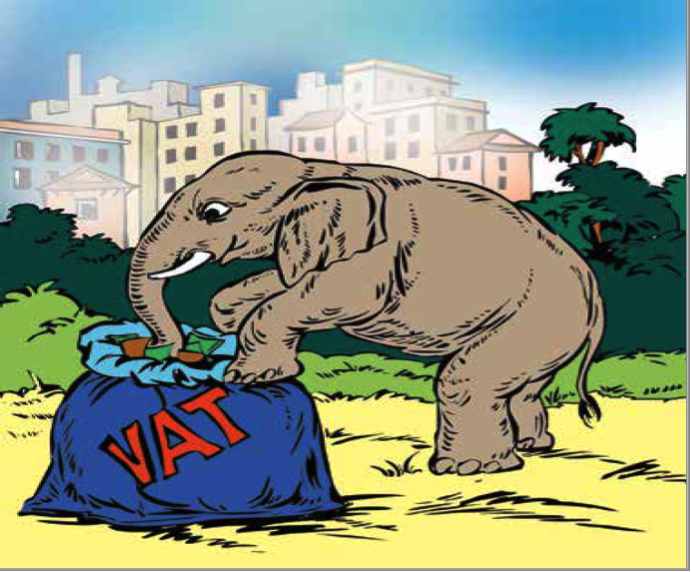
In spring 2010, Nepal’s Inland Revenue Department (IRD) seized fake Value added Tax (VaT) invoices that were being sold at local stationeries. amid reports that companies used these invoices to evade taxes a story appeared on CNN online about a report prepared by the IRD on VaT evasion having gone missing, possibly because business elites had influenced the Finance Minister. The CNN piece reported that fake VaT invoices had been used to evade almost Rs. 20 billion in taxes, and also named some businesses that were allegedly involved in the scam. These reports surfaced in the wake of the resignation of the Finance Secretary who was said to have quit following ‘disagreements’ with the Finance Minister. Some newspapers even speculated that it was possible he resigned over a dispute with the minister on how to handle VaT evasion. Parliament had also raised questions on this issue to which the government had not provided a satisfactory response.
In the meantime, Freedom Forum obtained information from the Ministry of Finance (MOF) that the Depart-
ment of Revenue Investigation had formed a special five-member task force led by a deputy director, for the investigation in 2010. It had submitted its report to the Director-general of IRD, who had forwarded it to MOF after which there had been no decision. The information received by Freedom Forum suggested that 515 businesses had used fake invoices to evade about Rs.10 billion in taxes. No action had been initiated because a decision was pending.
RTI process
Taranath Dahal, Chair, Freedom Forum, filed an RTI application with the MOF seeking information on the tax evaders, on 08 May 2011. He wanted to know the names of VaT evaders (both individuals and businesses) and also the amount of revenue lost. He had asked for copies of the ‘Investigation Report on Tax evasions using Fake and Duplicate VaT Invoices, 2010’ and its annexures 1-7.
The MOF did not provide the information within 15 days of the application, as required by law. Neither was the petitioner given a reason for not being provided the requested information. Next Dahal took his case to the Finance Secretary, the first appellate authority, on 09 June 2011. The Finance Secretary did not respond immediately, and later said he was unable to make the disclosure. Responding to the resulting appeal, on 11 July 2011, the NIC ordered the Finance Ministry to provide, within three days, either the requested information, or an explanation to the Commission. The MOF did not comply with the order. Dahal made another appeal to the NIC on 15 august 2011.
On its part, the MOF, on 20 July 2011, sought the opinion of the attorney general’s Office and was advised against disclosure because of the ‘confidential’ nature of the in- formation under tax laws. earlier, on 21 June, the Ministry of Finance, through a ministerial decision, had also decided that the information could not be disclosed. It had used a similar argument to deny information while responding to the NIC’s 11 July order.
Disclosure
Eventually, the Ministry of Finance disclosed the information on 30 October 2011. This was in response to the NIC’s final decision that stated that the requested information was a matter of public concern and therefore the petitioner had the right to be informed. The NIC added that it was the public’s right to know if the taxes they
paid had reached the exchequer, or had been stolen, and that people had the right to know how certain businesses might have taken the money using fake invoices. The order read, “If such scandals are made public, the concerned can be discouraged, and similar crimes are likely to be prevented. Transparency discourages while concealment of public information could encourage such malfeasance. Therefore, people will be deprived of information if the probe report on tax evasions is kept secret” .
The Ministry of Finance disclosure said that a total of 518 companies had been investigated but information on only 437 was disclosed. While the reported loss in taxes was Rs. 10 billion, because information on 81 companies in the probe report was not released, there was reason to suspect that the losses could have been higher. The remaining information was not available because the NIC directed the MOF to make public information con- tained in only four out of the seven annexes that had been requested. The remaining 81 firms were still under investigation at the time and this information was later obtained from IRD.
Follow-up requests
Not satisfied with the partial disclosure, Dahal made an- other information request at IRD. He asked for the names of the 518 companies, their owners, the violations and the total amount to be recovered. IRD refused to register the application on 06 august 2012, saying the informa- tion sought was protected under the Right to Privacy. Next, he took the application to the Director-general (28 august 2012), the head of office, where first appeals for information denial 4 are filed. The next day a director at IRD provided some information that said the govern- ment needed to recover Rs. 6.59 billion of evaded taxes but did not disclose the names of companies that had defaulted. The tax office said the information was pro-
tected under Section 3.2 of the RTI act and also Section 74 of the Revenue act that has provisions for protecting taxpayers. an appeal was filed before the NIC on 07 Oc- tober 2012. The RTI act gives the NIC 60 days to take a decision on a complaint or appeal. after this time had elapsed, the applicant wrote to the NIC requesting a re- sponse on the status of the application.
Interestingly, on 14 February 2013, IRD Director-general Sharma filed a case against Freedom Forum and the National Information Commission at the Supreme Court, demanding certiorari and mandamus order in his favor. In this regard, Freedom Forum took the stand that those evading tax are not taxpayers but criminals. So, they need not have their privacy protected as argued. With this stand, Freedom Forum submitted its written response to the SC on 15 March 2013, and reasoned that it had the right to get the information sought. The case was sub- judice at the SC when this document was prepared.
Impact
The information received showed how policy level in- action could affect public interest, particularly on an is- sue that was tantamount to stealing from the treasury. The disclosures also provided moral support to honest policymakers, government officials and law enforcers, who were previously unable to disclose the information because of the influence of some big businesses on the government. There was higher tax collection in 2012 in comparison with 2011, and this could have been influ- enced by the RTI disclosures. On 12 august 2012, Saurya Dainik (a vernacular daily) published a report that said revenue collection had increased by 27 percent in the first month of the fiscal year. The Monthly Tax Bulletin of IRD in July-august 2012 also reported an increase in col- lection by Rs. 3 billion, and it attributed this to successful reforms in revenue administration. The disclosure also received wide coverage in the media. The knowledge that some tax information could be disclosed can also serve as deterrent to potential defaulters. The government began action to recover the defaulted tax but was challenged by businesses at the Revenue Tribunal. On 04 September 2012, the tribunal ruled in favor of the government, and all of this was possible even though the disclosure of information was only partial.